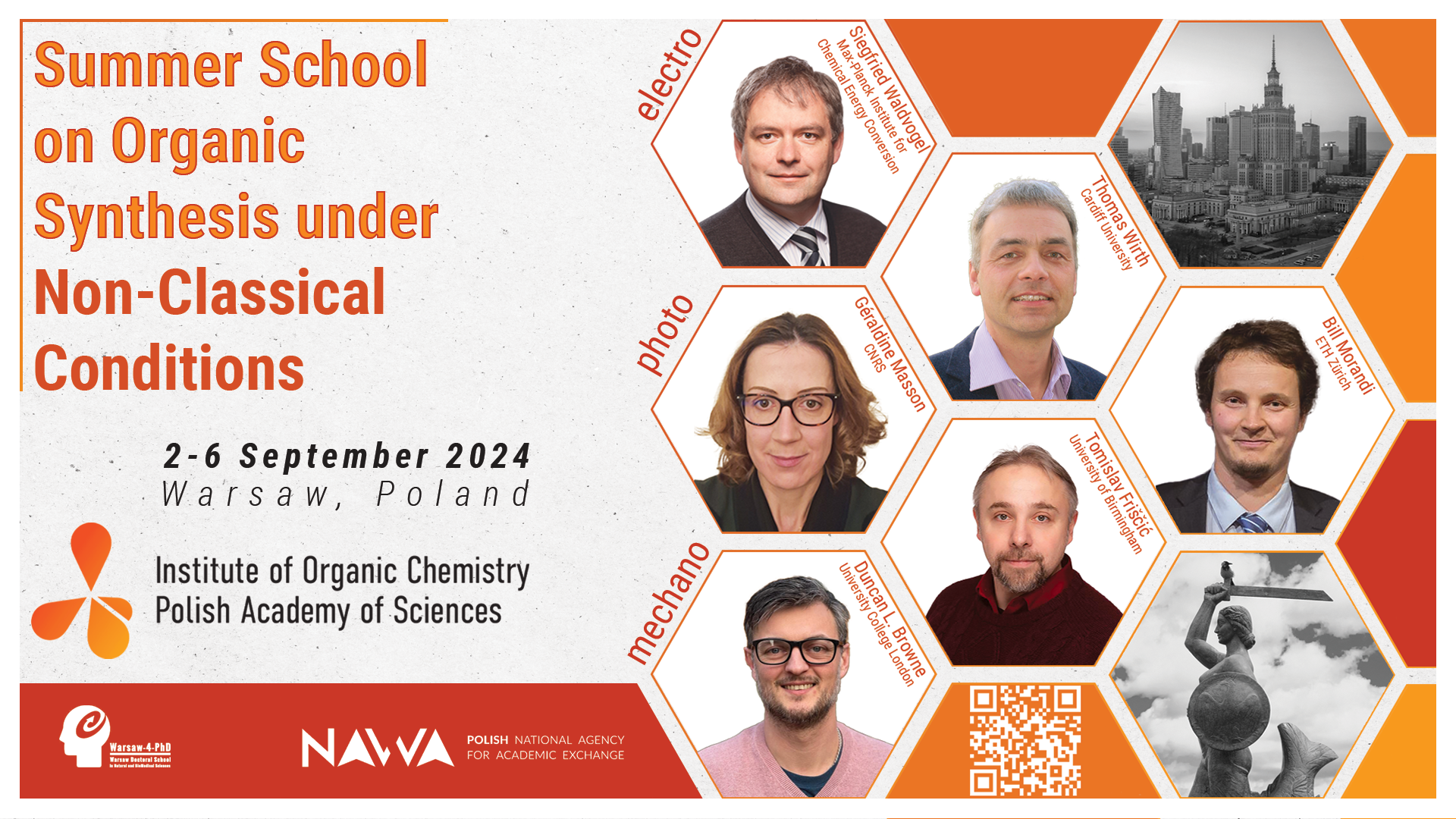
Mamy przyjemność zaprosić Państwa na konferencję pod tytułem “Summer School on Organic Synthesis under Non-classical Conditions”, która odbędzie się w dniach 2-6 września 2024 roku, w Instytucie Chemii Organicznej PAN.
Będziemy gościć czołowych naukowców z całej Europy, którzy podzielą się najnowszymi osiągnięciami w dziedzinie syntezy organicznej prowadzonej w niestandardowych warunkach.
Tematyka Szkoły Letniej skupi się na trzech kluczowych obszarach syntezy organicznej:
The Warsaw Doctoral School in Natural and Biomedical Sciences and the Institute of High Pressure Physics PAS cordially invites you to a SPOTLIGHT TALK.
The talk is given by Prof. Eugen Rabkin (Department of Materials Science and Engineering, Technion – Israel Institute of Technology, 3200003 Haifa, Israel).
When and where?
8thMay 2024 2024, 12:30 pm at the IHPP PAS New Technologies Building, Al. Prymasa Tysiąclecia 98 Duration: 60 min + more
Abstract
We studied the uniaxial compression behavior of micro- and nanoparticles of several elemental metals (Au, Ni, Ag, Mo, Pt) and alloys (Ni-Co, Ni-Fe, Au-Ag, Cu-Au). The particles were obtained by solid state dewetting of thin metal films and bi-layers deposited on sapphire substrates. The high homological temperatures employed in dewetting process ensure the low concentration of dislocations and their sources in the particles. The particles compressed with a flat diamond punch exhibit purely elastic behavior up to very high values of strain approaching 10%, followed by a catastrophic plastic collapse. The uniaxial yield strength of the particles defined as an engineering stress at the point of catastrophic collapse reached the astonishing values of 34, 41 and 46 GPa for the smallest faceted particles of Ni, disordered Cu3Au, and Mo, respectively. The atomistic molecular dynamic simulations of the particle compression demonstrated that the catastrophic plastic yielding of the particles is associated with the multiple nucleation of dislocations at the facet corners or inside the particles. The latter, homogeneous nucleation mode resulted in higher particle strength. The size effect in compression was observed both in the experiments and in atomistic simulations, with smaller particles exhibiting higher compressive strength. We discussed the stronger size effect observed in the experiment (as compared with simulations) in terms of the effect of residual defects trapped in the particles. Finally, we produced Au-Ag core-shell nanoparticles by coating the single crystalline Ag nanoparticles with a polycrystalline Au shell. The core-shell nanoparticles exhibited much lower strength than their single crystalline pure Ag counterparts. We related this decrease in strength with the active role of grain- and interphase boundaries in the polycrystalline Au shell in decreasing the energy barrier for dislocations nucleation.
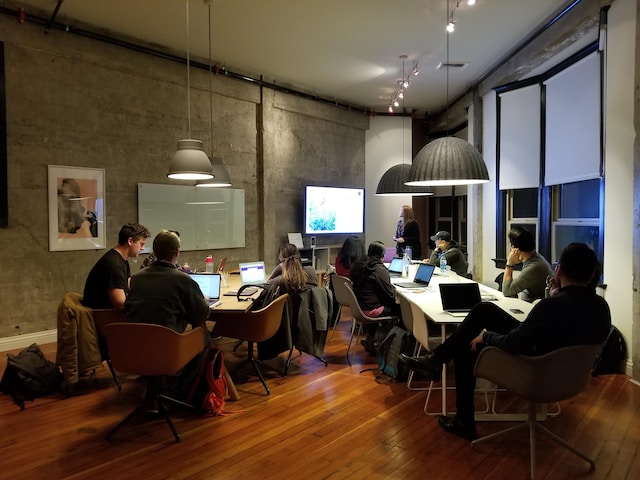
The STER workshop runs over five days, with each day dedicated to a specific topic. The school is a workshop aimed at PhD students and young researchers in physical chemistry to familiarise themselves with the latest topics in physical chemistry.
World class lecturers
A tutorial lecture will be given by an internationally renowned speaker followed by lectures by students and local experts.
Register now – limited number of places.
Don’t miss this opportunity to learn from our guests and get feedback on your research. Young researchers can apply for talks or poster presentations.
The Warsaw Doctoral School in Natural and Biomedical Sciences and the Institute of High Pressure Physics PAS cordially invites you to a SPOTLIGHT TALK.
The talk is given by Prof. Eva Monroy (Quantum Photonics, Electronics and Engineering Laboratory, PHELIQS of CEA-Grenoble, France).
When and where?
24th April 2024, 13:00 pm at the IHPP PAS New Technologies Building, Al. Prymasa Tysiąclecia 98, seminar room, 2nd floor Duration: 60 min + more
Abstract
The COVID pandemic triggered a demand for UV lamps for disinfection, which was initially met with low-pressure mercury lamps. Presently, there is a transition towards the use of AlGaN LEDs, which are regarded as a safer and more environmentally sustainable alternative. Despite their advantages, the efficiency and cost-effectiveness of LEDs at 270 nm remain low due to several unsolved challenges, including the optimization of electrical injection. Moreover, the 250-270 nm spectral range, which corresponds to the peak efficiency for disinfection, is associated with risk of cancer and cataracts, prompting research into alternative UV sources with reduced penetration depth, notably within the 220-230 nm spectrum. In this domain, cathodoluminescent UV lamps emerge as a viable solution to obtain substantial radiant power while mitigating associated health risks.
This presentation will focus on the development of efficient UVC emitters by exploring the growth of AlGaN/AlN dots-in-a-wire structures, quantum dot superlattices, and ultrathin GaN/AlN quantum wells using plasma-assisted molecular beam epitaxy. For nanowires, we fine-tune growth conditions to ensure uniform active regions suitable for electron beam interaction. With quantum dots or wells, we optimize aluminum content and growth conditions to achieve strong emission at wavelengths below 230 nm. These nanostructures show internal quantum efficiency higher than 50% and maintain performance under varying pumping power, making them versatile for different device applications.
The Warsaw Doctoral School in Natural and Biomedical Sciences and the Institute of Physics PAS cordially invites you to three ADVANCED LECTURE SERIES – OXIDE MATERIALS FOR OPTOELCTRONICS talks.
Talks are given by prof. dr hab. Leonid Dubrovinsky (University of Bayreuth, Bayreuth, Germany).
When and where?
Talks are divided into three lectures on April 15th, 16th and 17th 2024, each preceded by short introductory talks, at the IP PAS Leonard Sosnovski Auditorium.
The Warsaw Doctoral School in Natural and Biomedical Sciences and the Maria Sklodowska-Curie National Research Institute of Oncology cordially invite you to a SPOTLIGHT TALK.
The talk is presented by William James Becker, PhD (National Institute of Health, National Cancer Institute, Vaccine Branch).
9th, 10th and 11th April 2024, 12:00 pm at the Maria Sklodowska-Curie National Research Institute of Oncology, ul. W.K. Roentgena 5, seminar room im. Prof. Jana Steffena, 4nd floor
Introduction to Flow Cytometry – on 9th April 2024, 12:00